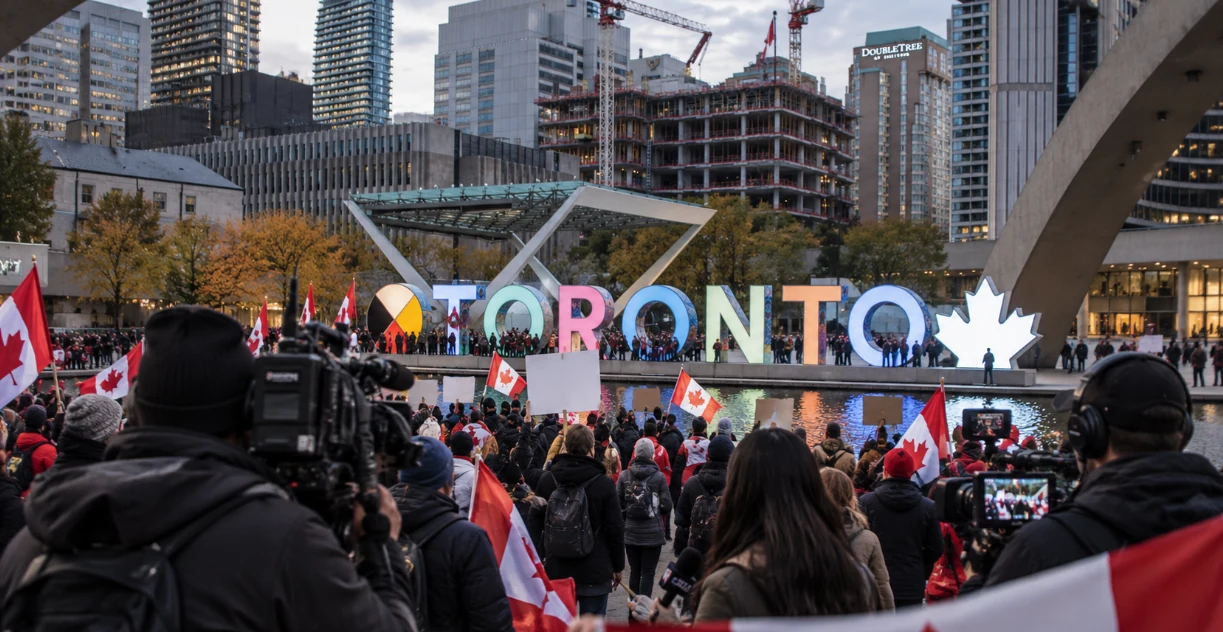
A crowd photograph can hold your attention before you have read a word. Faces, flags and the scale of a public space give a story immediacy. Understanding that story takes another step: finding out what the image is being used to claim.
Separate the scene from its explanation.
You may be able to describe visible features: people standing together, a camera in the foreground, a building or a sign. Those observations do not establish the date, the purpose of the gathering, how many people attended or what everyone believed.
The creatives in this publication are editorial illustrations of public life in Toronto. We have not identified them as documentation of a particular movement or event. Their captions make that distinction so the surrounding article can be assessed on its own sources.
When you see a photograph elsewhere, read its caption and credit. Ask whether it is current, archival, illustrative or supplied by an organiser. A missing answer is a reason to keep the context open. A familiar landmark alone does not complete the story.
Find the precise claim.
“People gathered” and “a group achieved a policy change” are different claims, requiring different evidence. A picture may show a scene, while an account of a decision needs a record of that decision. An organiser’s statement tells you what the organiser says; it does not automatically establish every detail independently.
Look for a named source, a date and a description of what happened. If an attendance figure appears, ask how it was obtained and who supplied it. If a report describes everyone in a crowd as holding one view, look for the evidence supporting that description.
Consider this illustrative reading exercise: a social post shows a square and says a public meeting is happening “this evening.” Before passing it on, find the original notice and its date. A screenshot can keep circulating after the invitation has changed. This example describes a checking method, not a reported incident.
Choose a source that can answer the question.
For a listed event at Nathan Phillips Square, the City’s schedule provides a place to begin and links onward to event details. Check the organiser’s current information for the format and practical arrangements. An event’s absence from one calendar does not settle whether a gathering took place. Read the square’s schedule
For a broader search, Toronto’s Festivals and Events directory points to City and community event information. Keep the identity of the organiser clear when reading a listing. Explore the event directory
For a claim about a City project, read the relevant engagement page and its updates. For a formal agenda item, use the City’s meeting information. Match the source to the claim rather than collecting links that simply repeat the same caption. City project pages Council and committee information
Explore the original resources.
Primary sources reviewed on 11 October 2026. Consult the current official listing for dates, availability and participation instructions.